
Disk Rotation — Does the Disk Rotate on Its Axis?
This article examines the mathematical disk used to represent the Moon in the standard model. Instead of referring to SM (Spinning Moon) or NSM (Non-Spinning Moon), we introduce the corresponding notions at the level of the model: SD (Spinning Disk) and NSD (Non-Spinning Disk).
Does the disk rotate on its own axis? Conventional astronomy implicitly assumes SD. This article examines that assumption using only Euclidean geometry. No forces, no dynamics, and no reference frames are introduced at this stage.
The conclusion follows directly: the Disk does not rotate on its axis.
Geometry of the standard model
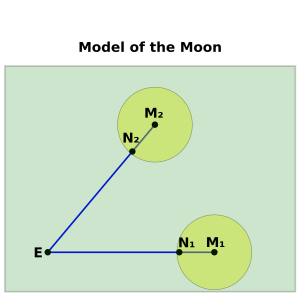
The standard model consists of a disk revolving around a fixed point while maintaining the alignment of three points:
- E — center of the Earth (fixed point)
- M — center of the Moon
- N — nearest point on the Moon (origin of selenographic coordinates)
In all representations — static or animated — these three points remain aligned as the disk revolves around E.
Proposition
In the plane, a segment that rotates about a fixed point cannot simultaneously rotate about another point.
Geometrical result
Segment EM rotates about point E and therefore cannot rotate about point M. Segment NM, being part of EM, follows the same constraint. Since the disk is rigidly attached to segment NM, the conclusion follows:
The disk does not rotate about its center M.
FAQ
F1 — Can reference frames rescue SD?
No. Only one reference is used here: the Euclidean plane. In that setting, segment NM rotates about E, not about M.
Reference frames are addressed separately in the article Moon Rotation.
F2 — Can composition of motions rescue SD?
No. The motion can be constructed step by step using straightedge and compass by rotating segment NM about E. Any additional rotation about M would break the alignment of E, N, and M.
F3 — Can circular translation rescue SD?
We refer here to the right-hand figure commonly used in explanations (see, for example, the NASA page on tidal locking:science.nasa.gov/moon/tidal-locking/, or the Wikipedia article on tidal locking:en.wikipedia.org/wiki/Tidal_locking).
If the right-hand figure is interpreted as NSD, then, by symmetry, the left-hand figure must be interpreted as SD. The question therefore becomes: can circular translation explain NSD in the right-hand figure?
No. A circular translation would require different rotation centers for N and M. If both rotate about E, maintaining orientation requires an additional rotation — meaning that the disk does rotate in that alternative model.
The right-hand figure is therefore misleading. Its intuitive appeal creates a strong illusion, similar to that of a Ferris wheel gondola, which appears not to rotate despite undergoing a rotation about its suspension axis.
Gilbert Vidal — retired engineer (France)
 Euclidean Moon Rotation