Home | Disk Rotation | Moon Rotation | Libration | Appel
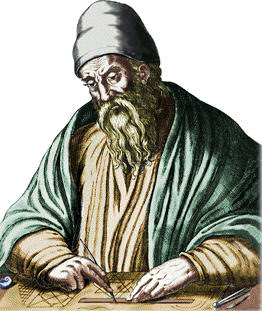
Euclid (4th–3rd century BC)
Euclidean Moon Rotation — Does the Moon Rotate on Its Axis?
It is generally assumed that the Moon rotates on its own axis. This conception will be referred to as SM (Spinning Moon).
This site examines the opposite conception, the NSM (Non-Spinning Moon), using only Euclidean geometry.
It shows that the usual interpretation of the standard model contradicts elementary geometry. The conclusion follows directly: the disk representing the Moon in the standard model does not rotate on its axis.
It then shows that the Moon behaves like the disk, in accordance with the principles formulated by Henri Poincaré regarding conventions and the method by which a theoretical model is connected to physical reality.
Articles
Start with the article Disk Rotation because any subsequent argument depends entirely on this purely geometrical analysis.
Then read the full argument in the article Moon Rotation.
Disk Rotation
A strictly geometrical analysis of the standard model showing that the disk representing the Moon does not rotate on itself.
Moon Rotation
This article shows that the Moon behaves in the same way as the disk, and it also provides additional material to support discussion and to outline the broader implications for the Solar System.
Libration
A Python simulation reproduces the longitudinal libration (alternate rotation) . It can also simulate its continuous rotation and confirm, through dynamics, the result obtained through geometry.
FAQ
SM = spinning Moon
NSM = non-spinning Moon
FAQ1 — Does the Moon rotate?
The standard interpretation says yes. This site shows that this interpretation contradicts Euclidean geometry.
FAQ2 — Shall we eradicate SM if we opt for NSM?
Probably not totally, due to the SM implication in the catalogs of sidereal periods and spin-orbit resonances. See S4A.
FAQ3 — Why does an astronaut on the Moon see the stars rotate?
This is usually explained by Moon rotation on itself. This explanation is examined in S4B.
FAQ4 — Why do we always see the same side of the Moon?
This is usually explained by synchronous rotation. This explanation is examined in S4C.
Gilbert Vidal — retired engineer (France)