
In conventional astronomy, the mathematical disk representing the Moon is described as rotating on its axis as it turns around a point representing the Earth. This article analyzes that claim using only Euclidean geometry.
Geometry of the Standard Model
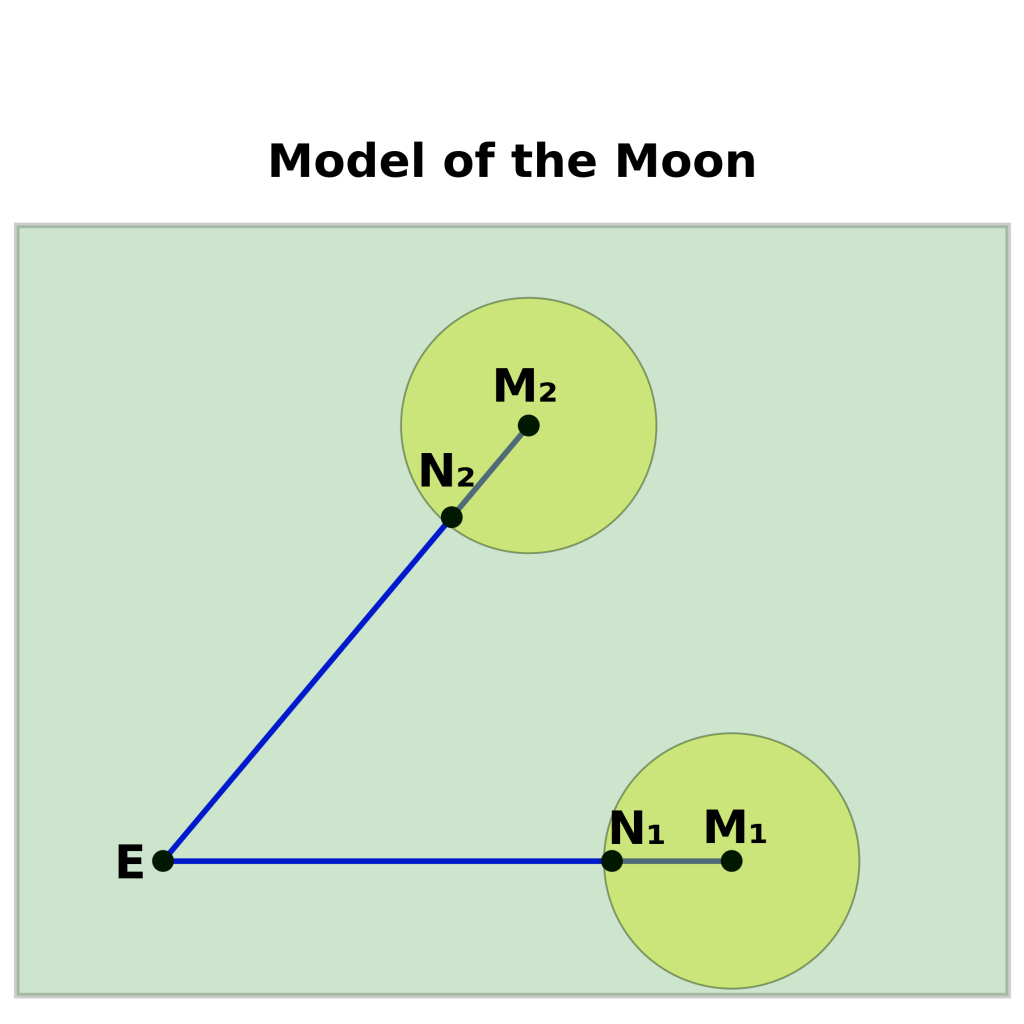
Regardless of its presentation, the standard model is characterized by a disk rotating around a fixed point while maintaining the three following points aligned:
- E (Earth) represents the center of the Earth. It is the only fixed point in the figure.
- M (Moon) represents the center of the Moon.
- N (Nearest) represents the origin of selenographic coordinates. This is the point on the Moon closest to Earth, near the crater Mösting A.
Whether the model is represented statically, as shown above, or dynamically, as in standard animations 1, one can always identify three points — E, M, and N — which remain aligned throughout the motion as the disk revolves about point E.
Proposition
In the plane, a line segment rotating around a fixed point cannot rotate around another point.
Analysis of the Model
According to the above proposition, the segment EM rotating around the point E cannot rotate around the point M. The same applies to the segment NM because it is part of the segment EM. But the disk is attached to the segment NM. Consequently the disk does not rotate about its center M.
¹ See the NASA page on tidal locking (https://science.nasa.gov/moon/tidal-locking/) and the Wikipedia article “Tidal locking” (https://en.wikipedia.org/wiki/Tidal_locking). Each presents two figures: the left shows the standard representation of the Moon, while the right shows a hypothetical configuration in which the disk spins synchronously with its revolution, but in the opposite direction.
 Euclidean Moon Rotation